I’ve been thinking a lot lately about how much energy I’ve wasted just trying to strangle a specific outcome into existence. It’s funny, in a sort of tragic way, how we are taught from the very beginning that the only way to get what you want is to chase it down until it’s cornered.
We’re fed this diet of “hustle” and “grind” and the idea that if things aren’t working out, it’s simply because we haven’t applied enough force. But recently, I had this moment of clarity, the kind that hits you when you’re finally too tired to keep running, where I realized that I have been my own biggest obstacle.
I’ve been the noise that’s preventing the music from being heard. I started looking at the things in my life that actually work, from the tiny tech gadgets in my pocket to the massive systems of the universe, and I noticed something unsettling: everything performs better when I get out of the way.
It started with the small stuff, the things I mentioned before, a desktop hanging, a website unresponsive, the wifi crawling at a snail’s pace. My natural reflex was always to interfere. I’d refresh, I’d reset, I’d poke, I’d scream. I’d try to fix the code while the site was still crashing, only to realize I was making the glitch permanent.
And then one day, I just didn’t. I sat back. I let the laptop spin its little wheel of death without mashing the keys. And like a ghost in the machine, it cleared its own path. The “hang” was just a pause, a moment the system needed to recalibrate, to breathe, to sort through the million commands I’d recklessly thrown at it.
When I stopped adding more weight, the machine fixed itself. It made me wonder: if technology, something we built to be efficient, needs a pause to function, why do I think I can override that law in my own life?
This theme of the “pause” has become the centerpiece of my journey over these last few months. It hasn’t been about quitting or giving up; it’s been about stepping back enough to stop suffocating the results I claim to want.
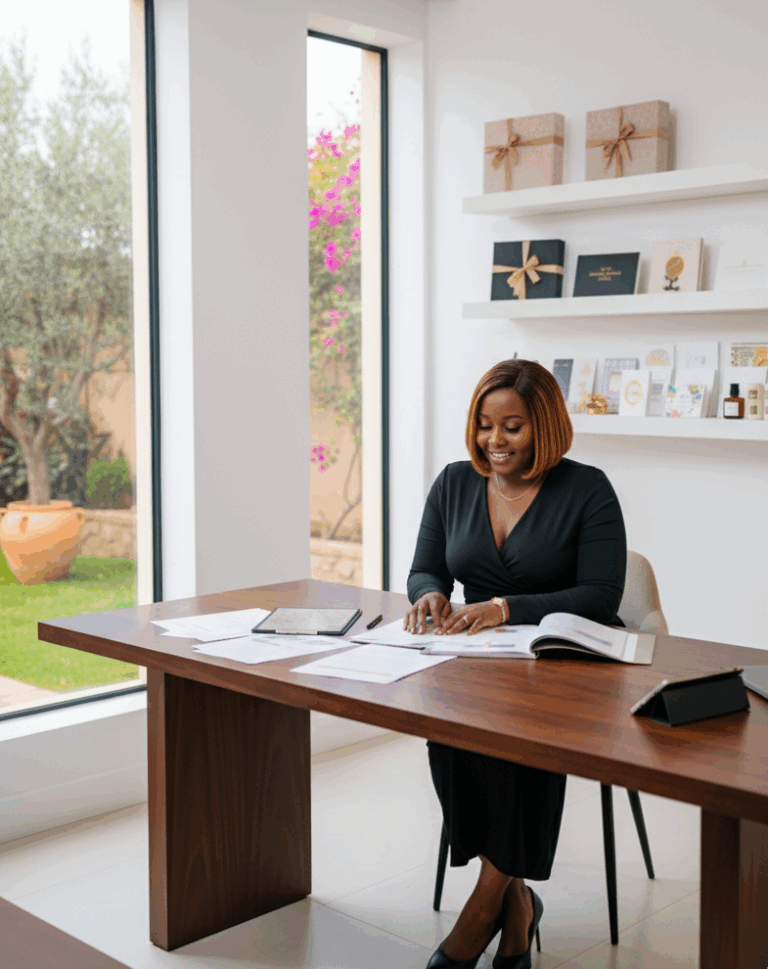
For so long, especially in my business, I was operating in a state of pure, unadulterated “chase.” I was running my gift shop like a marathon runner who doesn’t realize they’re on a treadmill.
I was chasing clients who weren’t actually buyers, they were spectators. You know the type. They ask a hundred questions, they consume your energy, they want the backstory and the “behind the scenes,” but when it’s time to actually commit, they vanish.
I spent so much time over-explaining, over-promising, and trying to convince people who already weren’t aligned with what I was doing. I thought that if I could just explain it one more time, or offer one more discount, or be one more version of myself, the sales would come. I was strangling the business with force.
And then, April happened. I call it the month of alignment, but really, it was just the month I finally got tired of being a performer. I stopped the chase. I stopped entertaining the draining inquiries that led nowhere. I stopped trying to be everything for everyone. I put up my boundaries, separating my business from my personal life, turning that old number into “calls only,” and reclaimed the mental space I didn’t even realize I’d signed away.
I decided that if someone wanted what I had, they’d find me, and if they didn’t, no amount of me “chasing” them was going to change their heart. And that’s when the strangest thing happened. The moment I loosened my grip, things started coming to me.
Aligned clients, the ones who pay on time, who appreciate the work, who communicate with kindness, just started appearing. The “spectators” were replaced by “buyers.” I realized that all that time I spent chasing the wrong people, I was actually broadcasting a frequency of desperation. And desperation is a repellant.
It’s like when a phone freezes because you’ve opened too many apps; my life was frozen because I was running too many “desperation” background processes. By closing those apps, the constant worrying, the over-reaching, the people-pleasing, the system of my life finally had enough RAM to actually process success. Sales started coming in, not because I was working “harder,” but because I was finally operating from a place of peace.
It made me realize that force is for machines, but alignment is for humans. When we force things, we are essentially saying to the universe that we don’t trust it. Chasing is rooted in a deep, hidden distrust that life won’t provide for us unless we corner it.
But pausing? Pausing is an act of faith. It’s the recognition that there is an intelligence in the silence. Look at how a seed germinates. It’s underground, in the dark, in total stillness for weeks. If you kept digging it up to “check on it” or to “fix” how it’s growing, you’d kill it. The growth happens in the dormancy.
Or look at how muscles grow. They don’t grow while you’re lifting weights; they grow in the hours after, while you’re sleeping, while you’re at rest. The work is just the catalyst; the pause is where the results are integrated.
I’ve had to apply this to my emotional healing, too. For a long time, I obsessed over the details of why things didn’t work out, or how someone could treat me a certain way. I tried to “solve” my feelings with force, as if I could think my way out of a broken heart.
But the more I obsessed, the more disoriented I became. It was only when I stepped back, when I actually waited out the emotional storm, that clarity returned.
Distance revealed truths that my “chasing” mind was too clouded to see. I saw the incompatibilities I’d been trying to overlook. I saw the red flags I’d been painting white just so I could keep running. Silence didn’t make the feelings disappear overnight, but it removed the noise, and once the noise was gone, the truth was the only thing left in the room.
Even my physical health feels the difference. Our nervous systems aren’t built for the “permanently reachable” world we’ve created. We live in a culture that glorifies the “grind,” but your brain consolidates its memory and repairs your cells during the pause—the sleep, the rest, the moments where nothing is happening.
By unlearning the habit of constant output, I’ve given my body a chance to regulate itself. I’m no longer in a “state of emergency” just because the wifi is slow or a client is quiet. I understand that the universe, and my technology, and my life, actually perform much better when I am not hovering over them with a screwdriver and an anxious heartbeat.
Even our boundaries are a form of the pause. By making myself less accessible, I became more available to myself. When I stopped being permanently reachable to everyone with a question or a complaint, my nervous system finally stopped operating in “scarcity mode.” I stopped feeling like a fire station that was perpetually being called to non-existent fires.
And surprisingly, the world didn’t fall apart because I didn’t answer a text in ten seconds. People adjusted. The ones who valued me stayed, and the ones who were only there for the easy access drifted away. That’s the beauty of getting out of the way; it filters out the noise for you.
I used to think that the person moving the fastest was the person winning. I grew up in a world that glorified constant output, as if exhaustion was proof of my worth. But now I look at my life like a high-performance computer.
If I don’t reboot, if I don’t clear the cache, if I don’t give the processor a chance to cool down, I’m going to crash. And a crashed system can’t serve anyone.
This longing I have for a quieter life, for the garden, the greenery, the ducks, the “haunted house” far from the urban chaos, it’s all connected to this philosophy. I want to live in a space that respects the seasons. No tree blooms year-round. Every intelligent system knows when to shed its leaves and wait for the spring.
The biggest lesson of my journey so far is that urgency is usually an illusion born of panic. When we are panicked, we abandon our discernment. We settle for difficult clients because we’re afraid no one else is coming. We stay in draining relationships because we’re afraid of the silence.
But once you trust the pause, you realize that life is trying to lead you into doorways that you’re too busy running past to see. The universe isn’t withholding things from you; it’s just waiting for you to stop the frantic interference so it can deliver them to your door.
April was my “reboot.” I sat back, I folded my arms, and I waited. I stopped trying to force the wifi to work and just walked to the window to watch the sky. And wouldn’t you know it? By the time I walked back to the desk, the signal was strong, the page was loaded, and the alignment was complete.
We don’t have to be the “fixer” for everything that stalls. We just have to be the person brave enough to believe that space is not a vacuum, it’s an invitation.
The pause did not ruin my progress; it revealed it. And for the first time in years, I feel like I’m finally walking at the right pace. My own. Alone, maybe, but finally in step with the world around me.
I’m no longer chasing spectators; I’m just tending my own garden and letting the buyers find their way home. It turns out nine out of ten times, the best thing you can do for a “hanging” life is simply to stop clicking. It’ll catch up. It always does.