The first thing I hear is water.
Not traffic.
Not a neighbour’s television playing too loudly through a wall.
Not a boda boda revving somewhere outside the gate.
Water.
A soft, continuous sound coming from somewhere below the veranda, where the little waterfall drops over the black volcanic rocks into the pond.
I don’t even have to look to know it is running.
I’ve lived here long enough that I can tell what is happening outside without getting up.
The particular sound of the bamboo moving when the evening wind comes through.
The ducks making a ridiculous amount of noise when they think someone is about to feed them.
The faint metallic click of the gate.
Adriel’s bicycle wheels against the concrete path.
The solar pump kicking in.
The goats making those strange little sounds they make when they want attention.
And then there are the really quiet moments when there is almost nothing at all.
Those are my favourite.
I am sitting on the veranda now with a cup of lemongrass tea in my hands, watching the sun slowly disappear behind the Yatta Plateau.
The sky is ridiculous tonight.
Terracotta.
Copper.
Gold.
That deep dusty blue that only seems to appear for a few minutes before everything becomes dark.
The wind is warm, but not oppressive. It moves through the bamboo along the eastern boundary and carries that dry, clean smell of the countryside after the heat of the day.
I take another sip of my tea.
It came from the garden.
The lemongrass, at least.
I still find that funny.
There are things about this house that I have become so accustomed to that I forget how strange they once sounded when they existed only as ideas in my head.
I grow things here.
I collect rainwater.
I make energy from waste.
I grow fruit.
I keep ducks.
There is a fish pond in my garden.
There is a guest cottage that earns money when I want it to and disappears back into our private world when I don’t.
My business runs from a studio at the back of the house.
The sun charges our batteries.
The rain fills our tanks.
The garden gives back.
And somewhere in the middle of all of this, I live.
Not visit.
Not escape to.
Live.
That distinction still catches me sometimes.
Because this isn’t a holiday home in the way people usually mean it.
It is our home.
We simply happen to spend our long holidays here.
And maybe that’s the strangest part.
There was a time when I thought about this place as something far away.
Something for later.
Something I would build when I had “made it.”
Now I am sitting here barefoot.
My cup is getting cold.
There is a half-eaten mango on the table.
My phone is somewhere inside the house and, for once, I don’t care where it is.
Adriel is outside.
The dogs are asleep.
The ducks are making a mess of the pond.
And I suddenly have this very strange thought.
This is actually mine.
I still think that sometimes.
I don’t think I’ll ever completely stop.
We came here for the long holidays this time.
That has become our rhythm.
During the school term, we are mostly in the city. There are classes, business, appointments, errands, the usual movement of life.
But when the school calendar opens up and there is finally enough time to breathe, we pack the car.
Not dramatically.
No elaborate road-trip production.
Just bags, food, chargers, books, a few things for the garden and whatever Adriel insists he absolutely cannot leave behind.
And we drive.
The funny thing is that the closer we get, the quieter I become.
I don’t even consciously notice it anymore.
The city slowly gives way.
The roads change.
The buildings become fewer.
The landscape opens.
There are stretches where you can look ahead and see so much sky that it almost feels exaggerated.
And eventually, there it is.
Kithimani.
I remember why I chose this place every single time.
It wasn’t because it was the trendiest place.
It wasn’t because I needed to impress anybody.
It wasn’t because I wanted a retirement fantasy somewhere far away from everything.
I chose it because when I was actually thinking about the life I wanted to build, the numbers and the landscape and the practical realities kept pointing me here.
I wanted land.
Proper land.
Enough to build a real home without squeezing everything onto a tiny plot.
Enough space for trees.
Enough space for a kitchen garden.
Enough space for water harvesting.
Enough space for a guest cottage.
Enough space for Adriel to ride a bicycle without me constantly worrying about traffic.
Enough space for the business to have a proper studio.
Enough privacy that I could step outside and not feel like somebody was watching me through their curtains.
And I wanted to own it properly.
No endless estate service charges.
No committee deciding what colour my gate should be.
No monthly fee because somebody has decided my half-acre needs to belong to an “exclusive community.”
I wanted my title.
My land.
My decisions.
My responsibility.
That was the point.
I remember looking at different places before settling here.
Some were beautiful.
Some were more fashionable.
Some had better amenities.
Some had the kind of scenery people put on Instagram with captions about their dream life.
But when I actually sat down and thought about the life I wanted rather than the life that looked impressive, Kithimani made sense.
The climate made sense.
The land made sense.
The space made sense.
The agricultural possibilities made sense.
The accessibility made sense.
The ability to build something that wasn’t dependent on an estate management company made sense.
And, perhaps most importantly, I could see myself here.
Not a fictional version of myself.
Me.
A woman who wanted quiet.
A woman who loved plants.
A woman who wanted to design her own environment instead of adapting herself to someone else’s.
A woman who wanted her home to function as beautifully as it looked.
A woman who wanted her son to have space.
A woman who wanted her work close enough to touch but not close enough to consume every waking hour.
That was the brief.
And eventually, I built it.
I still remember the first time I stood on this land.
It looked nothing like this.
That is probably the funniest part.
There was no bamboo.
No pond.
No moon bridge.
No house.
No beautiful veranda.
No fruit trees.
Just land.
Open sky.
Soil beneath my shoes.
A few people talking somewhere in the distance.
Wind.
And me standing there trying to mentally place an entire life onto an empty piece of earth.
I walked the boundaries.
I looked at the slope.
I imagined where the house would sit.
Where the guest cottage would go.
Where the pond would collect water.
Where the orchard would begin.
Where the studio would get the best light.
I could almost see it.
Almost.
But imagination is funny because the first version is always cleaner than reality.
The actual building process was dusty.
Noisy.
Expensive.
Messy.
There were decisions everywhere.
Materials.
Measurements.
Deliveries.
Workers.
Delays.
Things that had to be changed.
Things I thought would cost one amount and somehow cost another.
There were mornings when I stood in the middle of the construction site with my hands on my hips thinking,
What exactly have I gotten myself into?
But I wanted this house too badly to build it carelessly.
I didn’t want some generic suburban house that could belong to anybody.
I wanted the building itself to feel like it belonged to the landscape.
So we made the walls from interlocking stabilized soil blocks.
ISSB.
The soil from the land itself became part of the house.
There is something deeply satisfying about that.
The ground beneath the house is also part of the walls.
The walls aren’t covered up with layers of plaster pretending to be something else.
I left them exposed.
Terracotta.
Geometric.
Warm.
A little imperfect.
They change throughout the day depending on the light.
In the morning, they’re soft.
By afternoon, they become warmer.
At sunset, they almost glow.
And against them I put dark timber.
The exposed cypress posts and beams are probably one of my favourite parts of the house.
They make the living room feel grounded.
The roof extends well beyond the walls, creating deep shade around the house and protecting the earth blocks from heavy rain.
I wanted the house to have that contemporary Chinese courtyard feeling I had been carrying around in my head for years.
Simple.
Warm.
Architectural.
But still unmistakably African.
Not a replica of somebody else’s home.
Mine.
Inside, I went completely against the part of me that used to think every beautiful home had to be covered in tiles.
There are no ceramic tiles everywhere.
I chose engineered bamboo flooring for the living spaces.
It is warm underfoot.
The kind of floor that makes you want to walk around barefoot.
The bathrooms are different.
Dark epoxy.
Smooth.
Almost seamless.
Easy to clean.
That was intentional.
I have no interest in designing a beautiful home that becomes a full-time cleaning project.
I wanted beauty to make my life easier, not harder.
The toilets are wall-hung.
The sinks float.
The pipes disappear.
There are no awkward little corners where dust collects and I have to kneel down with a cloth because some designer decided the pedestal sink looked prettier.
The electrical sockets are placed where I can actually reach them comfortably.
The doors have simple lever handles.
Everything has a reason.
That is probably the biggest difference between this house and the houses I used to admire from a distance.
This one isn’t designed to impress somebody walking through it for ten minutes.
It is designed for me to live in for decades.
I thought about future me while designing it.
Future me with slower knees.
Future me carrying groceries.
Future me moving furniture.
Future me cleaning.
Future me waking up at six in the morning.
Future me at seventy.
I didn’t want to build a house for the woman I was trying to impress.
I built it for the woman who would actually have to live here.
The water system might be my favourite part.
Rain falls on this roof and I don’t look at it as weather anymore.
I look at it as a resource.
The roofs of the main house and guest cottage feed into the collection system.
The first dirty runoff gets diverted.
Then the cleaner rainwater goes into the underground tank.
Fifty thousand litres.
Sometimes I still laugh at that number.
Fifty thousand litres sitting underneath the earth.
Waiting.
The water is pumped up using solar power into the overhead tank.
It passes through filtration before it enters the house.
The water we drink goes through an additional gravity filter.
It tastes different from the water I grew accustomed to in the city.
Softer.
Cooler.
Fresh.
And because the plumbing is split, I don’t have to use the same quality of water for everything.
The water that comes through the house is rainwater.
The water that leaves the house isn’t simply waste.
It becomes part of the landscape again.
That was important to me.
I wanted the property to behave more like an ecosystem than a house.
Water comes in.
Water gets used.
Water gets cleaned.
Water feeds the garden.
The garden feeds us.
Waste becomes energy.
Energy powers the systems.
The systems support the home.
The home supports us.
Everything has a relationship with something else.
The biogas system was one of those things I knew I wanted before I even fully understood how satisfying it would be to use.
There is an underground digester beneath the property.
The waste from the house and guest cottage goes into it.
The resulting methane comes through a pipe into the kitchen.
And yes, I still find it mildly hilarious that I can stand in my kitchen cooking dinner using gas produced by the household’s own waste.
There is something beautifully circular about it.
I turn on the stove.
The flame appears.
I cook.
And I know I didn’t have to go into town to buy a cylinder.
The bioslurry becomes part of the orchard.
The trees grow.
The fruit comes.
And I stand under those trees months later eating something that was grown partly because of a system that started underneath my house.
It makes me feel like I cheated somehow.
Like I discovered a secret.
The garden is where the house really comes alive.
The land slopes gently, so I worked with the slope rather than fighting it.
The main pathway curves down toward the pond.
It is wide.
Smooth.
Step-free.
I wanted to be able to walk around this place easily as I get older.
No unnecessary stairs everywhere.
No dramatic landscape feature that becomes a hazard after sunset.
The pathway is lit by small solar bollards in the evening.
They come on automatically as darkness settles.
And the effect is beautiful.
You can see the path glowing softly through the garden.
Not bright.
Just enough.
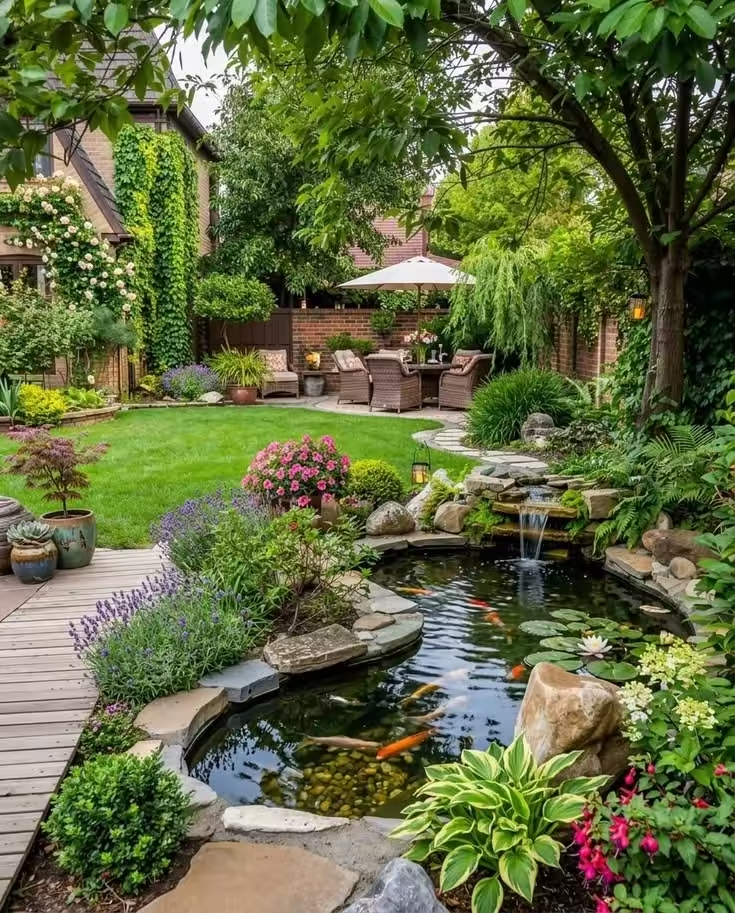
The pond sits lower down.
It is not enormous.
It doesn’t need to be.
But it is alive.
There are ducks.
Fish.
Water lilies.
Plants around the edges.
And that little waterfall.
The pump runs during the day from its solar panel, circulating the water and sending it back over the volcanic rocks.
Sometimes I sit on the moon bridge for no reason.
I don’t meditate.
I don’t journal.
I don’t manifest.
I don’t make a five-year plan.
I just sit.
That’s something I didn’t understand when I was younger.
Not every quiet moment needs to produce something.
Sometimes sitting on a wooden bridge watching fish move through water is enough.
Sometimes the most productive thing you can do is absolutely nothing.
Adriel has become particularly fond of this part of the property.
He rides his bicycle down the path.
Stops.
Feeds the ducks.
Checks the fish.
Then somehow comes back covered in dirt.
Every single time.
I don’t know how he does it.
He can be clean for approximately eleven minutes.
Then he’s outside again.
And I let him.
There is something beautiful about watching a child have space.
Not a mall.
Not a screen.
Not a tiny patch of grass surrounded by cars.
Actual space.
Land.
Trees.
Water.
Animals.
Sky.
He knows which plants are edible.
He knows where the ducks sleep.
He knows which fruit is ready.
He knows that the goats are going to try eating whatever they aren’t supposed to eat.
He knows how to ride down the slope without crashing.
He knows this place.
This is home to him.
The orchard is still one of my favourite parts of the property.
Mangoes.
Avocados.
Papayas.
Citrus.
A few other things I’ve planted simply because I wanted them.
During the right season, the trees become ridiculous.
There is fruit everywhere.
I walk outside and don’t have to think about whether there is anything to eat.
I pick something.
Wash it.
Eat it.
That’s it.
There are herbs near the water garden too.
Mint.
Lemongrass.
Ginger.
Things I can reach for while cooking.
The kitchen garden changes with the seasons.
Some things thrive.
Some things don’t.
I’ve learned that gardening is a good way to lose your ego.
You can plan everything perfectly and a plant will still decide it has other ideas.
I’ve stopped taking it personally.
The goats have also taught me humility.
I have three.
They are supposed to be helpful.
Technically, they are.
They keep the grass down.
They provide manure.
They are part of the little ecosystem.
But they also have personalities.
And apparently their favourite hobby is finding the one thing I specifically told everyone not to let them near.
I once spent an entire afternoon looking for one because I couldn’t find it anywhere.
Eventually Adriel found it.
In the most ridiculous place imaginable.
He was laughing so hard he couldn’t even explain where it was.
I just stood there thinking,
This is my life now.
And I loved it.
Then there is the guest cottage.
That was one of those decisions where I wasn’t sure whether I was being practical or slightly delusional.
I wanted somewhere for guests to stay.
But I didn’t want guests inside my house.
I like people.
In controlled doses.
So the cottage sits behind the bamboo and bougainvillea, with its own entrance and a separate path.
It matches the main house without looking like an extension of it.
High ceilings.
Clay-tile eaves.
A little private courtyard.
An outdoor bathroom.
Plants everywhere.
It is beautiful.
And when I feel like making money from it, I list it.
When I don’t, I don’t.
That is the luxury.
I don’t need every square metre of my property generating income every second.
Sometimes the cottage is occupied.
Sometimes my family stays there.
Sometimes friends come.
Sometimes it sits empty for three months.
I decide.
There is something incredibly satisfying about having an income-producing asset that doesn’t demand my attention every day.
And the guests it attracts are not necessarily people coming for some glamorous countryside holiday.
Some are people working around the area.
Consultants.
Surveyors.
Professionals who need somewhere quiet and comfortable to stay.
People who want good internet, privacy, a clean bed and somewhere they can actually hear themselves think.
It turns out there is a market for peace.
I understand why.
I live here.
My studio is on the other side of the house.
This part makes me especially happy.
Because my business came with me.
I didn’t leave the ambitious part of myself in Nairobi.
I just stopped allowing it to occupy every room in my life.
The studio has huge windows.
Natural light floods in.
The worktables are organized.
The machines have their own spaces.
Everything has a place.
There is enough room to move around.
I can walk in, work intensely, and walk out.
Sometimes I work for four hours.
Sometimes six.
Sometimes I get completely absorbed in a project and look up to realize it is much later than I thought.
But eventually I close the laptop.
And when I do, the business stays in the studio.
That separation is sacred.
I don’t want to carry my work to the veranda.
I don’t want to answer messages while sitting beside the pond.
I don’t want to look at my garden and think about SEO.
There is a time for work.
And then there is a time when I am simply a woman sitting under a tree.
I think that is one of the greatest luxuries I built into this place.
Not the solar panels.
Not the guest cottage.
Not the water tank.
The ability to leave work behind.
Sometimes I walk around the property at night.
No particular reason.
I just want to see it.
The solar lights are on.
The house glows through the windows.
The bamboo moves in the wind.
The pond catches pieces of moonlight.
There are insects everywhere.
The sky is enormous.
And because we are away from the intensity of the city, the stars seem much closer.
I stand there sometimes and think about design.
Not as a profession.
As a way of living.
Because I realize that this house is really just a giant landscape architecture project I get to inhabit.
Every line has a reason.
Every tree has a purpose.
Every water flow has been considered.
Every opening frames something.
Every material was chosen deliberately.
Even the silence feels designed.
And perhaps that’s why I feel so at home here.
The place speaks the same language I do.
Adriel is growing up quickly.
That part is almost unfair.
One minute he is small enough to fit comfortably beside me on the sofa.
Then suddenly he is riding a bicycle around half an acre like he owns the place.
Which, technically, he does.
Or he will.
That’s another reason I wanted the land.
I wanted something tangible.
Something that could exist beyond me.
Not just money in an account.
Not just a business.
Not just things that can disappear because the market changes.
Land.
Trees.
A house.
A place.
A foundation.
Something he can point to one day and say,
“My mum built this.”
That matters to me.
Not because I need him to worship me.
But because there is something beautiful about giving your child an actual sense of belonging.
He knows where home is.
He knows the mango tree.
He knows the pond.
He knows the path.
He knows the smell of the kitchen when I’m baking.
He knows where the spare keys are.
He knows that if he wakes up early enough during the holidays, he can find me outside with tea.
He knows that home is not necessarily a building.
It is the collection of ordinary things that become yours.
There are mornings when I wake up before everyone else.
Those are my favourite.
The house is still.
The light comes through the curtains.
I hear the birds before I hear anything else.
I make tea.
Sometimes I sit outside.
Sometimes I walk through the garden.
Sometimes I check the water levels.
Sometimes I just stand there.
I don’t rush.
That might be the strangest part of this life.
I don’t rush.
There is nowhere I urgently need to be.
The business is not collapsing because I took an hour off.
The house isn’t waiting for me to solve some emergency.
The garden isn’t going anywhere.
The money is working.
The systems are working.
The machines are working.
The house is working.
And because everything doesn’t depend on me personally every second, I get to become a person again.
Not just the woman who gets things done.
Just me.
And then there are the holidays.
Those are different.
The house becomes louder.
Family comes.
The guest cottage fills up.
There is food everywhere.
Someone is always making tea.
Someone is always looking for a charger.
Adriel disappears outside with the other children.
The kitchen is constantly in use.
The veranda becomes the gathering place in the evenings.
And somehow, despite being the woman who loves solitude, I love those moments too.
Because the beautiful thing about having your own space is that you get to decide when you share it.
The gates can open.
And they can close.
Nobody is entitled to every corner of your life.
The cottage gives people space.
The garden gives children space.
The veranda gives adults space.
And when I have had enough, I can disappear into my bedroom and close the door.
No guilt.
No explanation.
No apology.
My house has enough room for everybody without requiring me to surrender myself.
That was part of the design too.
Tonight, though, it is just us.
The long holiday has started winding down.
Adriel has gone inside because apparently even he eventually gets tired.
The ducks have settled.
The waterfall is still running.
The sky is almost completely dark.
I finish my tea.
For a few seconds, I just sit there looking at the house.
The terracotta walls.
The timber.
The deep roof.
The warm lights behind the windows.
The garden disappearing into darkness.
And I have one of those strange moments where my mind suddenly travels backwards.
Not to anything painful.
Just to the first sketch.
The first rough idea.
The first time I thought about half an acre and wondered what I could possibly do with it.
The first time I thought about a pond.
The first time I drew the guest cottage.
The first time I imagined solar panels.
The first time I wrote down the idea of collecting rainwater.
The first time I thought,
What if I actually built this?
I didn’t know then how it would happen.
I didn’t know the exact year.
I didn’t know where every shilling would come from.
I didn’t know which business would fund which part.
I didn’t know which ideas would work and which would change.
I didn’t know how long it would take.
I only knew what I wanted the finished feeling to be.
And sitting here now, I realize that feeling is exactly what I got.
Not perfection.
Not some ridiculous fantasy where nothing ever breaks.
Things still break.
The pond pump sometimes needs attention.
Plants die.
Things need repairing.
The internet occasionally misbehaves.
The goats still escape.
I still have days when I am irritated.
I still have work.
I still have responsibilities.
This isn’t some magical bubble where life stopped being life.
It is simply a life that fits me better.
That’s what I wanted.
A life that fits.
I get up from the veranda and walk toward the garden.
The concrete path is cool beneath my feet.
The lights are already on.
The pond is dark except for the little reflections from the house.
I cross the moon bridge.
For a second I stop in the middle.
The water moves underneath me.
A fish breaks the surface.
Somewhere in the bamboo, something rustles.
I look toward the house.
Our house.
And I smile.
Because I think about all the times I imagined abundance as something enormous.
A number.
A business figure.
A certain car.
A certain lifestyle.
A certain kind of luxury.
And yes, I have those things now too.
I have money.
The business is profitable.
The investments are growing.
There is enough.
More than enough.
I can travel.
I can take Adriel on holidays.
I can buy beautiful things.
I can upgrade the machines when I want to.
I can take a random Tuesday off.
I can book a flight without turning it into a financial crisis.
I can walk into a shop and buy something because I genuinely love it.
But standing here, I understand something I couldn’t have understood before.
Abundance is also this.
A functioning home.
A full water tank.
Fruit on a tree.
A paid-off machine.
A child laughing outside.
A business that doesn’t need to consume me.
A guest cottage that earns while I sleep.
A garden that gives back.
A kitchen where I can bake whatever I want.
A bed I genuinely love sleeping in.
A refrigerator full of food.
A quiet evening.
The ability to close the gate.
The ability to open it.
Choice.
That’s abundance.
I walk back toward the house.
Adriel is standing in the doorway.
“Are you coming?”
“Yes.”
He disappears inside before I can answer properly.
I laugh.
Of course.
I follow him.
Inside, the house is warm.
The lights are soft.
The kitchen smells faintly of something sweet because apparently he has been looking for the cake I made earlier.
I put my cup in the sink.
I turn off the veranda light.
Outside, the garden disappears into darkness.
The house becomes quiet again.
Tomorrow we will probably go into town.
We’ll buy a few things.
Maybe I’ll work for a couple of hours.
Maybe Adriel will ride his bicycle.
Maybe I’ll bake.
Maybe I’ll spend half the afternoon doing absolutely nothing.
That is the beautiful thing about this place.
Nothing is demanding that tomorrow be extraordinary.
It can simply be another day.
And another.
And another.
There is something incredibly beautiful about reaching the point where your dream stops feeling like a dream because you’ve lived inside it long enough.
The house doesn’t feel miraculous anymore.
It feels normal.
The pond feels normal.
The trees feel normal.
The veranda feels normal.
The solar panels feel normal.
The guest cottage feels normal.
The land feels normal.
And perhaps that is the greatest evidence that it happened.
The extraordinary became ordinary.
The thing I once had to imagine deliberately is now the place where I leave my shoes.
I look out through the window one last time before closing the curtains.
The moon is high.
The bamboo is moving.
The garden is quiet.
And I think, very simply:
I’m glad I built this.
Not because it proves anything to anybody.
Not because somebody else will see it and think I’ve succeeded.
Not because I finally have a beautiful house to photograph.
I am glad because this place feels like me.
Everywhere I look, there is a decision I made.
A tree I planted.
A wall I designed.
A path I drew.
A room I imagined.
A system I engineered.
A little piece of a future I once couldn’t touch.
And now I can.
I can walk through it barefoot.
I can open the windows.
I can pick fruit from the garden.
I can hear my son laughing outside.
I can sit on the veranda at sunset with lemongrass tea.
I can watch the rain fill the tanks.
I can watch the garden turn green.
I can watch the seasons change.
And I don’t have to wonder whether I belong here.
I do.
This is home.
Tomorrow morning, the sun will come up over Kithimani.
The Yatta Plateau will catch the first light.
The solar panels will begin charging.
The ducks will start making noise.
Adriel will probably wake up hungry.
The garden will need watering.
There will be emails waiting for me.
There will be work.
There will be ordinary things.
And I will do them.
Slowly.
Unhurriedly.
In a house that I built on land that I chose, surrounded by a landscape I designed, with enough room for my work, my son, my plants, my quiet and all the versions of myself that still have somewhere to grow.
I close the curtains.
The room goes dim.
And before I turn off the light, I have one final thought.
There was never anything wrong with wanting this.
The house.
The land.
The quiet.
The trees.
The water.
The freedom.
The room to breathe.
I simply had to believe that a life could be designed around the things that mattered to me.
Then I had to build it.
And now I am here.
Not dreaming about home.
Home.